English
Curriculum Overview
Overall intent
Our curriculum equips students with the knowledge, analytical skills and confidence to succeed academically and to communicate effectively beyond the classroom. We develop discerning readers who can interpret both explicit and implicit meanings, question perspectives and bias, and engage thoughtfully with the range of texts and ideas that shape the world around them. Alongside this, we teach students to become confident and purposeful writers and speakers who can communicate with clarity, accuracy and influence.
Our curriculum is carefully sequenced from Year 7, building on students’ experiences at KS2 and developing the knowledge and core skills they will need as they progress towards KS4 and beyond. At KS3, we have deliberately pared back curriculum content to allow greater depth: essential knowledge and skills are explicitly taught, practised, revisited and developed with increasing sophistication. Recall and revision are embedded throughout so that students learn to retrieve, connect and apply what they know. We create much of our curriculum content and resources ourselves, allowing us to respond to the needs of our students while maintaining a clear and ambitious curriculum journey.
Central to our intent is a love of English. Through challenging and engaging literature from different periods, genres and perspectives, students encounter significant ideas, broaden their cultural knowledge and develop their understanding of themselves and the wider world. Curriculum development is an ongoing, cyclical process: as a department, we continually reflect on what students know, remember and can do and use this to refine our curriculum, teaching and resources. Regular CPD, collaborative planning and robust quality assurance support this process, alongside the considerable subject and examining expertise within the department.
Embedding literacy
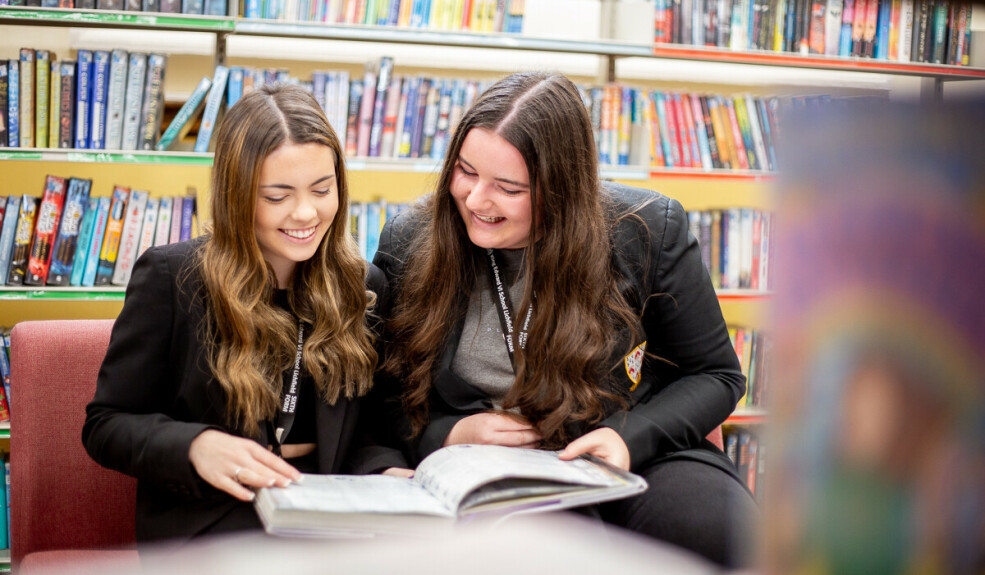
Reading, writing and spoken communication are at the heart of our curriculum. We explicitly develop students’ reading skills, including through reciprocal reading strategies, and students in Years 7 and 8 read regularly at the start of English lessons and in Accelerated Reader lessons in Year 8. NGRT testing helps us monitor reading and literacy development and identify students requiring further support, with additional core literacy provision provided in Year 8 where appropriate.
Core literacy skills are deliberately revisited and developed across the curriculum rather than taught in isolation. Tier 2 and Tier 3 vocabulary is embedded purposefully and strategically, enabling students to access increasingly challenging texts and express increasingly sophisticated ideas. In writing, students learn to adapt effectively for different purposes and audiences, developing accuracy alongside control, flair and a growing understanding of how language can be crafted for deliberate effect. Wider reading and our links with the library complement this explicit teaching as we seek to develop confident readers who choose to read beyond the classroom.
Encouraging independence
We want students to become curious, thoughtful and increasingly independent learners who are willing to question ideas, perspectives and the world around them. Carefully selected texts and topics expose students to different social, historical and cultural viewpoints, encouraging discussion, debate and independent thought. Students are given regular opportunities for independent practice, research and extended learning.
Our approach combines high expectations with appropriate support. Departmentally devised scaffolding cards provide targeted support and challenge for lower and higher prior-attaining students, helping all students access ambitious learning while developing the confidence and strategies needed to work increasingly independently.
Enrichment
Enrichment extends students’ experience of English beyond the taught curriculum and helps foster a lasting enjoyment of the subject. Texts are selected carefully and strategically to broaden cultural knowledge, introduce students to significant literary works and perspectives, and provide opportunities to explore topical and challenging issues. Where appropriate, we adapt access rather than ambition; for example, the department has produced abridged versions of Shakespeare texts and other more challenging texts to enable lower prior-attaining students to engage meaningfully with important works.
Students experience literature in performance through visiting Shakespeare workshops, theatre visits and our Digital Theatre subscription. Opportunities beyond lessons include poetry competitions, Reading Club, our Letters and Ladders educational games club and a sponsored Year 12 essay-writing competition as well as several writing competitions aimed at different year groups. We also work with the More Able coordinator at KS4 and KS5 to identify opportunities for further challenge and academic enrichment. Together, these experiences are intended not simply to support examination success, but to encourage curiosity, cultural engagement and a genuine, lasting love of English.
Staff
The following members of staff form the English department at King Edwards:
| Staff Member | Job Title |
|---|---|
| Miss R Phillips | Head of Department |
| Dr E Coulbert | Second in English and Lead Teacher for Literacy |
| Miss H Keith | Assistant SENCo and English Key Stage 3 Coordinator |
| Mr R Bailey | Teacher of English |
| Ms A Bailiss | Teacher of English |
| Miss C Burns | Teacher of English |
| Mrs M Grainger | Teacher of English |
| Miss E Payne | Teacher of English |
| Miss E Smith | Teacher of English |
| Mr J Stephen | Teacher of English |
| Mr J Whitehurst | Teacher of English |
| Miss N Wright | Teacher of English |